
2024-04-03
Character Consistency at Scale: The Technical Problem No One Talks About
Beautiful AI frames are easy. Keeping the same character believable across hundreds of shots is a different production problem.
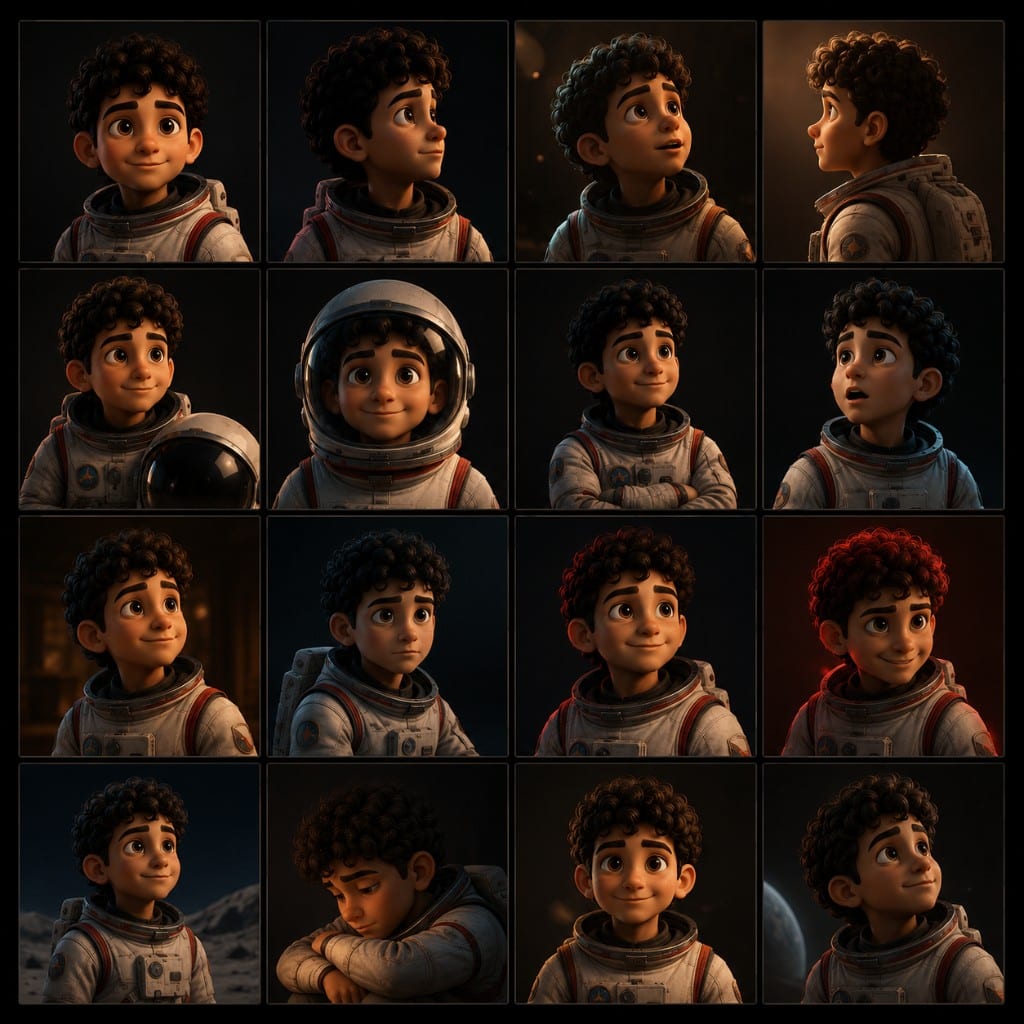
AI image tools are very good at producing a compelling single frame. Broadcast and streaming work rarely need one frame. They need the same character across 200 shots, six episodes, vertical cutdowns, thumbnails, promos, and sometimes merchandise. That is where the real technical problem begins.
Character consistency is not just "make him look similar." It is facial geometry, silhouette, costume logic, expression range, texture behavior, lighting response, and emotional continuity. A small shift in eye spacing can make a character feel like a cousin. A change in mouth shape can break a joke.
The workflow behind the frame
Our consistency pipeline starts before generation. We build reference sheets, pose maps, expression boards, costume rules, and negative constraints. For more demanding characters, we train LoRAs and run ComfyUI workflows that lock the geometry more tightly than prompt-only production can.
The goal is not to remove variation. Animation needs life. The goal is to decide which variation is performance and which variation is model drift. Lighting can change. Emotion can change. The face cannot quietly become someone else.
Where humans still own the work
The more technical the pipeline becomes, the more important direction becomes. Models can generate expressions; they do not know comedic timing. They can approximate sadness; they do not know how long a child character should hold a look before the audience feels it. They can create micro-expressions; they do not know which one belongs in the scene.
This is the difference between an AI image shop and an AI-native production studio. The tools create throughput. The studio protects the character.